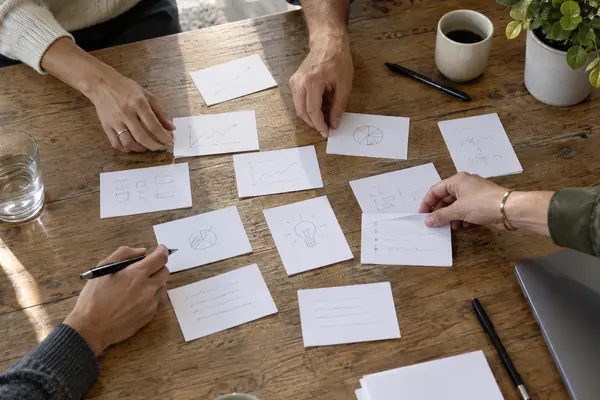
Psychology experiments point to a few simple conditions that help: moving, stepping away to something easy, and writing ideas down on your own before the group meets.
A 1987 review found that in 18 of 22 experiments, people working separately produced more ideas in total than the same number brainstorming aloud together.
Pick a way of getting ideas. The bar shows how well the experiments summarised here support it for generating lots of ideas.
Based on published experiments and meta-analyses on walking, incubation and brainstorming. Results vary by task and person.
TWO NUMBERS WORTH KNOWING
Feet help, crowds can hinder.
One figure on walking, one on what happens when a group brainstorms aloud.
81%
Participants whose creative score rose while walking
Walking raised 81% of participants' scores on Guilford's alternate uses test, but only 23% of scores on a test of finding a single right answer.
WALKING · STANFORD, 2014
18 of 22
Experiments where solo work beat real groups
In the experiments they listed, separate individuals out-produced real brainstorming groups in 18. The other 4, all with two-person groups, found no difference.
BRAINSTORMING · DIEHL AND STROEBE, 1987
Brainstorming was popularised by Alex Osborn, who claimed in 1957 that the average person could think up twice as many ideas in a group as alone. The experiments above tested that claim.
FOUR STEPS TO TRY
A better ideas session.
These steps work for a work project, a birthday plan or a story you are stuck on. They borrow directly from the experiments.
Load the problem first
Spend real time on it before stepping away. Longer preparation gave a bigger incubation effect in the Lancaster review.
Then go for a walk
Outdoors if you can. In the Stanford studies, walking outside produced the most novel and highest quality analogies.
Do something easy
Washing up, tidying or a gentle walk lets the mind wander. Save hard tasks for later.
Write alone, then share
Ask everyone to jot ideas separately before the meeting, then pool and build on them together.
AI-generated image, not a photograph of a real person or place.AI-generated image, not a photograph of a real person or place.
WHY GROUPS STALL
Waiting your turn costs ideas.
Osborn's brainstorming rules were simple: the more ideas the better, the wilder the better, combine and improve ideas, and do not criticise. The trouble is not the rules but the turn-taking.
Diehl and Stroebe tested three explanations: free riding, fear of being judged and production blocking. By manipulating blocking directly, they found it accounted for most of the productivity loss in real brainstorming groups.
Questions
Questions people ask
Does walking really make you more creative?
In four Stanford experiments it boosted creative idea generation, both while walking and shortly after. The effect was strongest on open-ended tasks such as listing new uses for an object.
Is group brainstorming a waste of time?
Not for building on ideas, but for producing lots of them it usually falls short. In 18 of 22 experiments, individuals working separately produced more in total than real groups.
What is production blocking?
In a group, only one person can speak at a time, so others hold or lose ideas while they wait. Diehl and Stroebe found it explained most of the shortfall in brainstorming groups.
Does sleeping on a problem help?
The research here looked at incubation breaks rather than sleep. A meta-analysis found a positive incubation effect, strongest for open-ended divergent thinking tasks.
What should I do during a break?
Something undemanding. In a 2012 study, an easy task that let the mind wander improved creative scores more than a demanding task, rest or no break.